
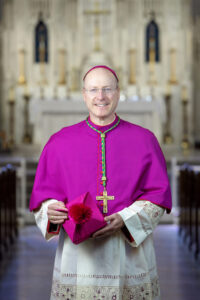
Archbishop Shawn McKnight
Archbishop of Kansas City in Kansas
October 5, 2026
As a person of faith, I believe our laws should reflect our highest moral aspirations, not our darkest impulses. Like many Americans of all political and religious persuasions, I was horrified by news from Tennessee regarding the botched execution of Christa Pike.
According to reports, the process stretched over more than an hour as officials struggled to carry out the procedure, leading to an extended and heavily disrupted event. The viewing curtain opened and closed repeatedly, allowing the assembled witnesses to observe parts of the attempted execution, before officials abruptly cut the microphone feed and closed the curtain for the final time. After receiving two full doses of lethal drugs, Ms. Pike remained on the gurney breathing and snoring, presumably the reason the microphone was turned off – so the sounds of her breathing would no longer be heard by the witnesses. She was subsequently transported by ambulance to a hospital, where she remains in critical condition.
Is this justice in America? Who among us can look at this spectacle and feel proud?
Moral conscience demands that we unequivocally condemn violent crime, support victims’ families, and honor the law enforcement professionals who keep the peace. But a premeditated execution performed by the state is the absolute antithesis of peace.
Consider the profound moral and medical conundrum this tragedy created. At some point in that chamber, an intentional effort to end a human life abruptly shifted into a frantic, ambulance-bound effort to save it. Now, a woman the state tried and failed to kill lies in a hospital bed at the public’s expense. What is the state’s next move? Will it send executioners to a hospital bedside to finish the job?
It is time to pull back the curtain on the grim reality of capital punishment. What happened in Tennessee was reminiscent of the cruel public spectacles that a decent society abandoned long ago. It proved once again that there is simply no humane way for the government to kill a human being. These state-condoned acts of vengeance don’t make us a better society; they wound us irrevocably. Even as we wrestle with the balance of accountability and mercy, surely, we can all agree that the state should not be permitted to kill in our name.
Now is the time for courageous moral leadership, especially here in Kansas. Today, nine men sit on our state’s death row. Governor Laura Kelly is vested with the constitutional authority to commute their sentences to life in prison without the possibility of parole. As she approaches her final months in office, she has a historic opportunity to demonstrate principled leadership. History judges leaders by how they use the authority granted to them through the votes of citizens. The death penalty returned to Kansas in 1994 when Governor Joan Finney allowed the legislation to become law without her signature, reportedly because she personally opposed it. But true leadership requires more than washing one’s hands of responsibility. In the wake of this week’s horror, Tennessee Governor Bill Lee rightfully suspended all scheduled executions in his state. If he could turn back time, would he have used his authority differently when asked to intervene? Will Kansas roll the dice and wait for our own Department of Corrections to attempt a similar horror? When we vote, we entrust public officials with the legal authority to lead with conviction. Governor Kelly holds that authority until January 11, 2027.
By commuting these death sentences to life in prison, Governor Kelly can protect our state from these grotesque spectacles, keep the guilty fully accountable, and ensure that the great state of Kansas rises above our most base human instincts.
Published for The Kansas City Star.
For all media inquiries, please contact the Office of Communications at communications@archkck.org.